
PART TWO: The Network
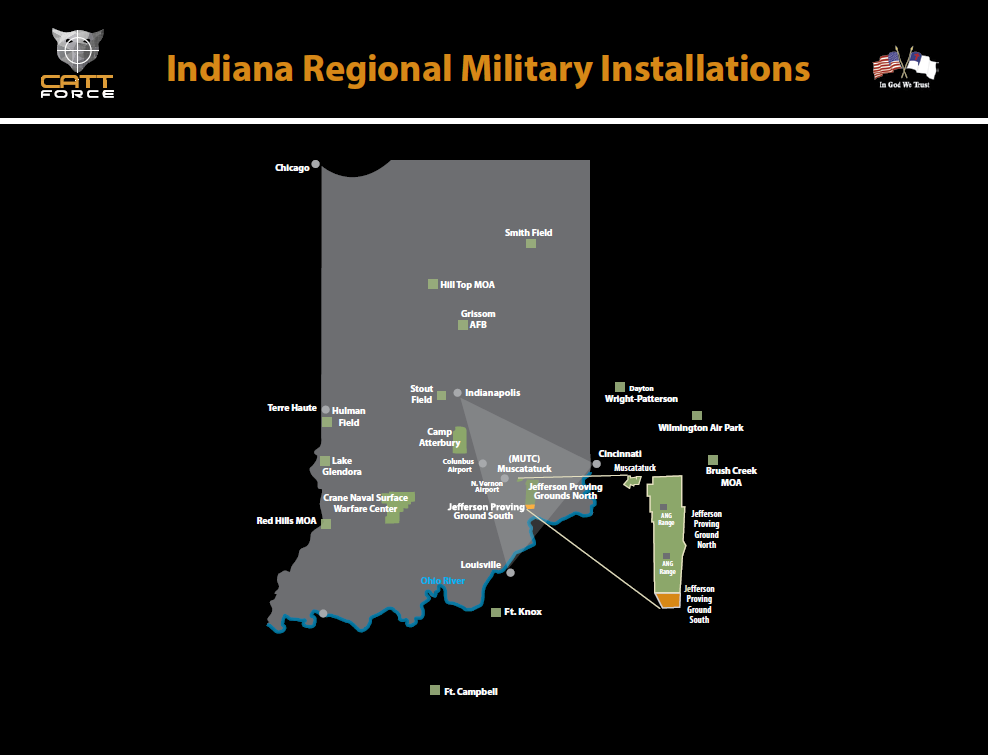
In the first installment of this series, we looked at how Crusader Advanced Tactical Training Force—an organization positioning itself at the intersection of Christianity and combat—secured access to over 100,000 acres of Indiana’s most sophisticated military training facilities.

[Quick Recap]
CATT Force advertises a “strategic partnership agreement” with the National Center for Complex Operations (NCCO), an entity hosted by the Sagamore Institute and sponsored by the Indiana Economic Development Corporation. In practical terms, the state of Indiana has stamped its approval on an organization that brands itself as a crusader force, wraps its operations in Christian iconography, and offers private citizens training in “unconventional warfare.”
A private, for-profit company with Christian nationalist branding is teaching insurgency tactics on taxpayer-owned military bases.
Selling Insurgency
CATT Force’s website advertises comprehensive training in “all areas,” including Unconventional Warfare (UW). This is not casual terminology. In U.S. military doctrine, unconventional warfare refers specifically to activities designed “to enable a resistance movement or insurgency to coerce, disrupt, or overthrow a government or occupying power.” It is proxy warfare. It is special operations conducted through local forces against an enemy state.
And CATT Force is selling these exact skills to the public, private, and academic sectors.
The organization promises “one-of-a-kind, one-stop-shop resiliency training” at multi-billion-dollar military venues. Its website displays the logos of the Indiana Economic Development Corporation, the 181st Intelligence Wing, and Camp Atterbury side-by-side, creating the impression of official endorsement. It claims to serve Special Operations Forces, federal agencies, NATO, border patrol, and law enforcement.
But the list reveals something darker than mere legitimacy-seeking. CATT Force sees itself as a military asset supplementing state power—with unregulated, untested, and ideologically charged capabilities. When you combine UW training with Christian nationalist symbolism, the question isn’t just who is paying for classes. It’s who they’re being taught to fight.
The Language of Militancy
The ideology behind the branding is not subtle.
Long before CATT Force LLC was formally registered in Indiana in 2017, the organization’s Twitter account (@CATTJPGS)—named after Jefferson Proving Ground South, one of its current training sites—posted a message in 2014 that remains telling:
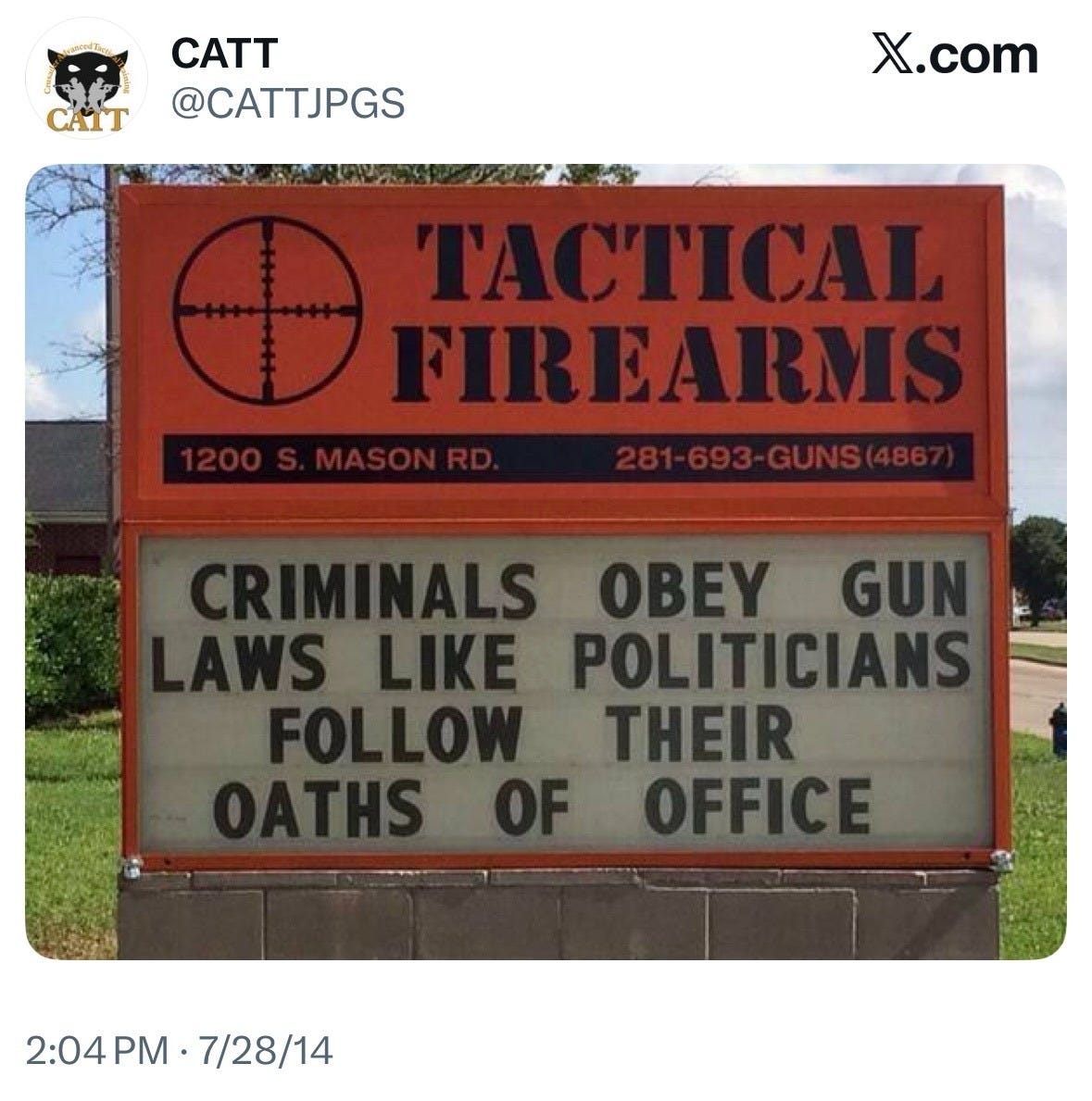
The implication is unmistakable. Politicians are failing their duties. Gun laws do not stop criminals. Therefore, tactical firearms training is the necessary response.
This was not framed as responsible gun ownership. It positioned the state as an adversary and private armed readiness as the solution. It is the language of militancy dressed in Second Amendment advocacy. And it came from the same entity that now claims a strategic partnership with the very state it once rhetorically opposed.
Today, CATT Force softens the edges but keeps the architecture. Its mission statement blends faith, patriotism, and paramilitary ambition, promising “multi-disciplinary resiliency training” for veterans and disadvantaged youth while serving government contractors and defense agencies.
“Resiliency” is a term of art in Christian nationalist circles. It often describes cultivating communities capable of withstanding persecution and remaining faithful under pressure. Paired with tactical training and military-grade facilities, “resiliency” shifts from self-care to preparation for conflict.
The Men Behind the Curtain
If the ideology provides the motive, the leadership provides the method.
CATT Force LLC was formed in March 2017 by Roger Curry and Kevin Presnell. According to his own bio, Presnell has founded “over 50 entities.” A search of the INBiz database suggests that number is conservative.
Presnell Transportation. Presnell Sporting Collection LLC. Feast Meats LLC. Farm Flex Finance LLC. Presnell Land Trust LLC. Presnell Development. Presnell Management LLC. Presnell Plantation. Just to name a few.
These are not dormant shells. They represent a pattern of launching, dissolving, and relaunching businesses across real estate, finance, agriculture, and development. Presnell Plantation LLC, for instance, received $174,329 in direct USDA farm subsidies according to the Environmental Working Group’s Farm Subsidy Database.

More troubling is the legal history tied to the property that now serves as CATT Force’s headquarters. In 2015, Presnell Plantation LLC and CATT Ministries Foundation were co-defendants in a foreclosure lawsuit involving more than $3 million in debt. The contested property—1950 S Morgantown Road—is now the operational base for CATT Force and its web of related entities.
These men are not off-the-radar patriots operating in secret. They are highly visible players in Indiana’s business registry, moving capital and assets through dozens of corporate vehicles. Their track record reads less like warrior-monks and more like opportunistic developers leveraging patriotic branding for commercial gain.
How Did This Happen*
CATT Force did not earn its credibility organically. It borrowed it—from the state.
The National Center for Complex Operations (NCCO) was incorporated by Indiana’s Lieutenant Governor in January 2012 as an “innovative mechanism for addressing national security needs while developing Indiana’s economy.” Sponsored by the Indiana Economic Development Corporation (IEDC), the NCCO acted as a bridge connecting state, federal, and private interests with military training capabilities at facilities like Camp Atterbury and Muscatatuck Urban Training Center.
Its founding executive director, Matthew Konkler, had served under Secretaries of Defense Donald Rumsfeld and Robert Gates before joining the Sagamore Institute. This was not a shadowy operation. It was a state-chartered economic development initiative with deep ties to Indiana’s political and military establishment.
CATT Force explicitly cites the NCCO as the source of its legitimacy. Its promotional materials state:
“Thanks to our strategic partnership agreement with the National Center for Complex Operations (NCCO), CATT is now approved to offer a comprehensive platform of resiliency training and educational opportunities, conducted at world class, fully modernized Military training facilities.”
The NCCO’s stated purpose was to streamline access to military facilities for vetted contractors—a sensible goal for economic development. But partnering with CATT Force raises serious questions about due diligence.
Did the NCCO examine CATT Force’s Christian nationalist iconography? Did it review the financial history, including the $3 million foreclosure involving CATT Ministries Foundation? Did anyone ask who would be trained in unconventional warfare—and for what purpose?
Hoosiers may never know.
The Question
Indiana has enabled this organization. The IEDC’s logo appears alongside CATT Force’s branding. The NCCO’s partnership is wielded as evidence of legitimacy. The state has effectively put its seal of approval on a paramilitary group with a Christian nationalist identity and unrestricted access to critical national security assets.
Why?
CATT Force does not specify who the enemy is in its marketing materials. But the iconography does the work. Crusader imagery signals a fight for Christian America—a nation portrayed in Christian nationalist rhetoric as under threat from secularism, Islam, immigration, and globalism.
This is not merely a story about real estate developers recycling corporate entities. It is about the normalization of Christian nationalism within national security contracting and the dangerously thin line between civilian training and para-militancy.
The state of Indiana has not explained how this happened or why it continues to allow CATT Force to trade on its name.